|
The Strategic Plan indicates that 22% of respondent households note a need for dog parks. In addition, Gallup polls (2001) indicate that for every 100 households, there are a staggering 79 dogs. Polls by Gallup, the U.S. Census Bureau (2001), and the American Veterinary Medical Association indicate that between 36 and 45% of Americans own one or more dogs.
In response to recommendations within the BREC Strategic Plan to provide new types of facilities, BREC Planning and Engineering Staff prepared a plan for investigation into off leash Dog Parks for the citizens of East Baton Rouge Parish.
BREC Planning and Engineering Staff incorporated the findings of the Strategic Plan, national research and analysis of dog parks, discussion with local dog club representatives and on-site analysis of other municipality's dog parks to develop criteria for site selection and site programming.
Dog Parks were found to be very successful throughout the nation with many recreational benefits for dog's and their owners. Based on these findings and the desire by many citizens of the Parish, BREC will pursue developing dog parks.
On-leash and Off-leash Public areas:
- On-leash Public Areas are characterized as public areas where the dog owner must maintain control of the dog at all times by means of a leash. East Baton Rouge Parish has a 'Leash Law' which requires dogs to be on a leash in all pubilc places.
- Off-leash Public Areas are those areas that are designated and properly secured for dogs to run free with other dogs and owners.
- General public/casual users
- Agility
- Show
|
- Hunting trainers
- Coursing
- Herding
|
- Tracking
- Flyball
- Obedience
|
- Small dog areas are separate areas set aside for smaller canines
- Large dog areas are areas set aside for larger canines
- Large special event areas are areas that are set aside for special event use such as an agility event, hunt test or coursing event.
- Building areas are covered, and enclosed areas that are used for dog events that require protection from the elements. Examples are dog shows and flyball tournaments.
The site should be non-linear to maximize usable space and buffered from traffic, sports fields, and children's playgrounds. Site should be fenced for safety. During site visits to other municipalities, it has been noted that separate small dog areas have been under-utilized. Construction of a special building for dog events is not economically feasible at this time. However consideration should be given to a site that could possibly use an existing building or have space reserved for a future building that could accommodate dog related events. Off street parking should be available to prevent traffic/dog accidents. Area should be at least one to three acres minimum. Larger areas are preferred to spread out use and to reduce dog/dog conflict. Area should also have positive drainage.
During research, it has become apparent that two "levels" of dog parks would be desirable.
- One level would be a community level park which would serve an area that has a high resident population but is not suitable for large dog events. A dog park of this type would not required a large amount of acreage, but would still be suitable for passive play and recreation.
- The other level would be a regional level dog park. This dog park could accommodate large events such as coursing, herding, retriever training and agility events. This size dog park can also double as a large community dog park when not being utilized for events.
- Smaller community dog parks should have basic amenities for both dogs and people. This includes restrooms, drinking fountains, trails and shade structures. A larger regional dog park should include these basic amenities as well as additional acreage for events and unique site features such as ponds.
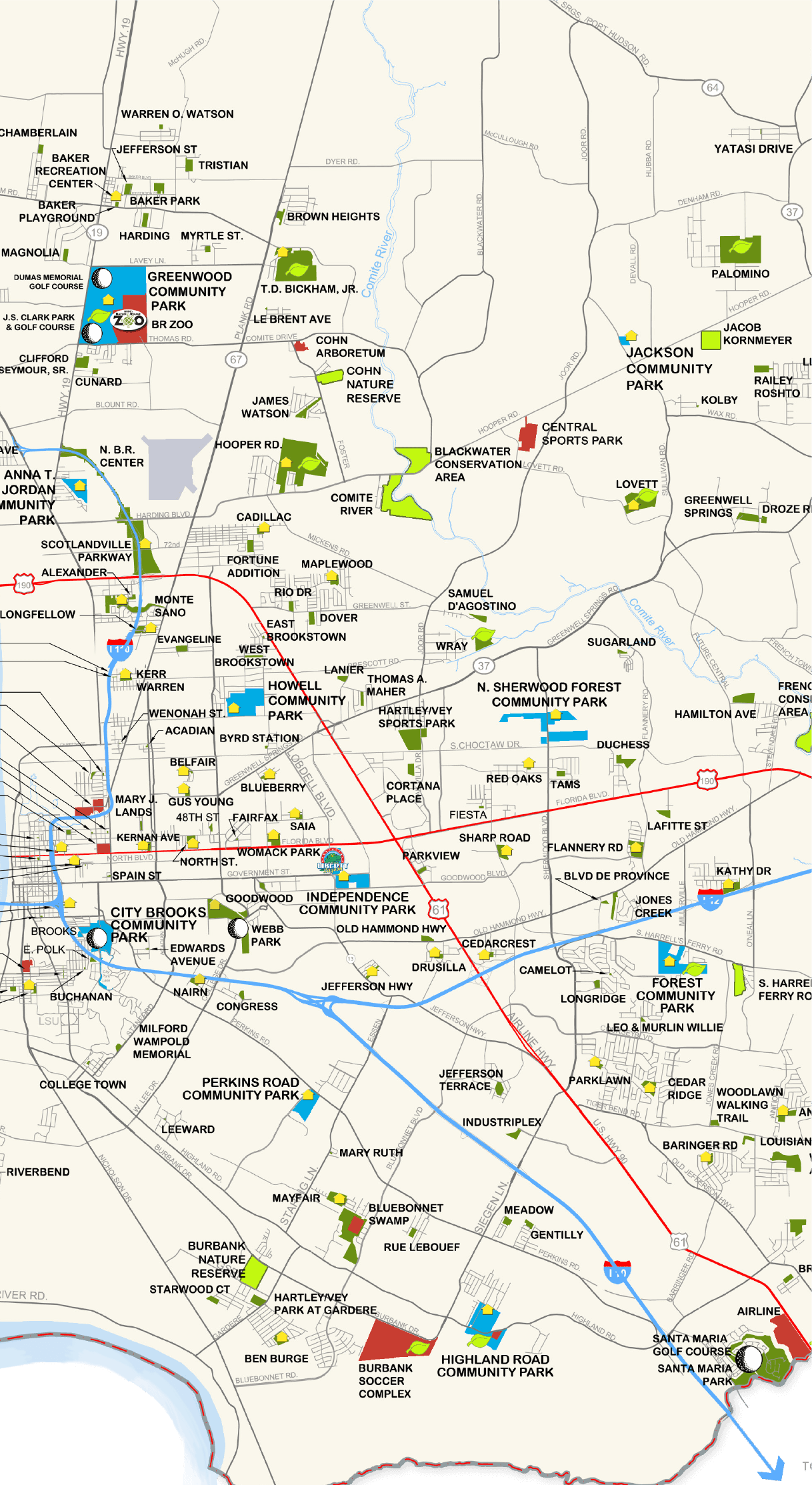
- Similar to the Community Parks recommended by the Strategic Plan, dog parks should be strategically located around the parish to serve the public. The service radius should be larger than a service radius for "people parks" to reflect a lower use rate than by humans. Smaller facilities should be located within areas of adequate acreage and near population centers to allow for easy use. Larger facilities should be located in the northern and southern portions of the Parish where undeveloped acreage for a larger facility is available and travel times are minimized.
Small parks are 1 or 2 acres. No less than 1 acre
Large parks over 2 acres
|